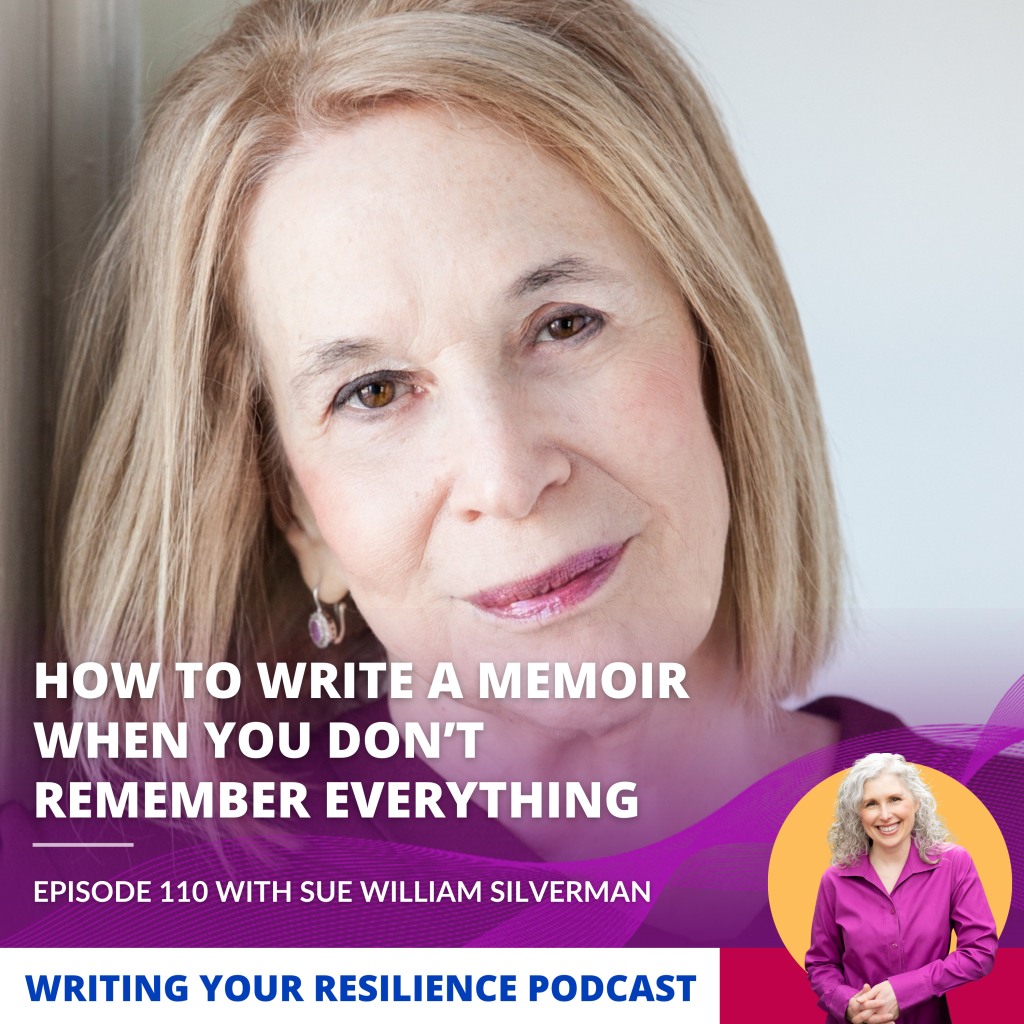
What do you do when the memory you need most for your memoir is the one you can’t quite reach? So many writers get stuck in the gaps, the holes, and slippery places where memory falters, especially when trauma is involved. It’s easy to let doubt keep you so stuck you stop writing. If you’re questioning how to tell your story or whether you’re allowed to tell it, today’s episode is for you. This week on Writing Your Resilience, I’m joined by award-winning author of nine works of nonfiction and poetry, Sue William Silverman, for a deeply honest, craft-forward conversation about what to do when you can’t remember—how to work with fragmented memory, how to use structure, voice, and sensory detail to tell the emotional truth of your story, and how to trust yourself even when certainty is impossible. If you’ve ever felt stalled by memory gaps, afraid of getting it “wrong,” or unsure how to write what you can’t fully recall, this episode will give you both permission and practical tools to keep going. Let’s dive in.
Lisa Cooper Ellison [0:03]
Lisa, welcome to Writing Resilience, the podcast for writers who want to write and live the story that sets them free. I’m your host, Lisa Cooper Ellison—a writer, transformational and trauma-informed coach, story alchemist, and fellow traveler on the winding road of healing and creativity.
Each week, I’ll share tools, practices, and conversations that will help you let go of what no longer serves you as you create stories that change lives—especially your own. Together, we’ll explore how to trust your creative voice, support your mental health and resilience, work with your nervous system and unique design, and stay connected to your deepest calling as a writer, even when life gets messy.
It’s time, my friends, to write and live the story that sets you free. I’m honored to walk that journey alongside you, one story and one episode at a time.
Well, hello, Sue. Welcome back to the podcast, and happy 2026. I’m so happy that you are here today.
Sue William Silverman [1:05]
Thank you. It is so nice to see you again. I mean, this is a great way to begin 2026—looking at your face and talking to you. So, thank you.
Lisa Cooper Ellison [1:13]
I feel exactly the same way. When I saw your name on my calendar, I was like, “Yes, it’s Tuesday!” I’m so excited.
Sue William Silverman [1:20]
Well, I do feel the same way. So, thank you for having me again. It’s really an honor.
Lisa Cooper Ellison [1:25]
Well, I’m really excited about the conversation that we’re going to have about what I would say is the number one issue that writers talk about, which is: What do you do when you don’t remember something and you’re writing a memoir? How do you navigate that?
We’re going to dive into that deeply, and we’re going to talk about the nuance in relation to how you navigate this. But before we do that, most people in the writing community know who you are, but there may be some people who are new to the podcast. They’ve never heard of you and your many, many books that you’ve written. What would you like people to know about you today?
Sue William Silverman [1:57]
Well, mainly that I write creative nonfiction. I started out writing two full-length memoirs with a straight-through narrative. My most recent book is Selected Misdemeanors: Essays at the Mercy of the Reader, and this is a collection of flash pieces.
In between, I’ve also written an essay collection. So basically, my arc as a writer has been from long-form memoir—say about 250 pages or so with a straight-through narrative—to now writing these flash pieces that are still thematically congruent, but very short.
Also, I’m the program co-chair of the low-residency MFA in Writing program at Vermont College of Fine Arts.
Lisa Cooper Ellison [2:44]
And I just want to say, shout-out to Selected Misdemeanors, because it recently won an award.
Sue William Silverman [2:50]
Well, it was longlisted.
Lisa Cooper Ellison [2:52]
Longlisted. I feel like it should win.
Sue William Silverman [2:55]
Thank you. Yeah, it’s the PEN Award for the Art of the Essay, and it’s longlisted with nine other books. We’ll see what happens. I’m not kidding when I say this—I’m so amazed that it got this far that I really am content if this is where it ends up. But we’ll see. They’ll be announcing the winner later this year.
Lisa Cooper Ellison [3:16]
Well, my fingers, my toes, and—I’m going to say—my eyes are crossed, hoping that you are the winner, because that is a huge deal. And yes, just to be longlisted is a big deal. That’s winning in and of itself. I’m just cheering you on because I’m a fan.
Sue William Silverman [3:31]
Thank you. That means a lot. It really does. Thanks.
Lisa Cooper Ellison [3:34]
Well, we’re going to get to our conversation today about what do you do if you cannot remember something in your memoir—especially if it’s a memory that feels slippery, has trauma in it, and you feel like you need to be able to trust yourself, and there’s something about this memory that keeps you from doing that.
You’ve written a lot of books, and I want to take us back first to that first book, because I remember Terror, Father, I Remember You. That’s your first memoir—the one that has that straight-through narrative. And the reason I want to talk about that book first is because, one, it’s that straight-through narrative, which so many people are trying to write, and it was the first write—the place where you didn’t know the rules, you didn’t know how to do things.
I’m curious to know what your process was like and how you engaged with the memories that you had. Did they come fully formed? Were you reaching for them? Did some come along the way? How did you navigate that process?
Sue William Silverman [4:34]
Yeah, so when I wrote it, actually the only memoir I’d read before that was The Diary of Anne Frank, which, you know, doesn’t count, because, you know, that’s Anne Frank. So, I really didn’t know what I was doing.
But I should hasten to add that I had spent ten years writing fiction before I wrote this first memoir—really bad fiction, these bad novels—but each of them was autobiographical. So, I was sort of trying to tell my story, and I think at that point I didn’t have the courage to just claim this as my story. So, I tried it as fiction for about ten years.
And then it was really my therapist who said, “Sue, why don’t you try writing your story as memoir?” Initially, I thought, I don’t have anything to say about myself. And he convinced me to try, and I did. And honestly, I wrote the first draft of the book in three months. So, in fact, I did have something to say about myself.
I didn’t really know what I was doing, but I just kind of went on energy. I followed my energy and started writing. And the writing process is so different from the thinking process. If I had just stayed in my head thinking, “Okay, did it happen this way? Did it happen that way? What happened? I don’t remember,” I still, to this day, probably would not have a book.
But the writing process itself helps engage your memory, particularly when you’re writing through the senses. The senses belong in the body—that’s where they live. They know a lot more than your head knows when it comes to this.
So, I started writing episodes through sensory memories. The two things that I remembered really clearly, both in my body and in my head, were that the house where I was born on Southern Avenue in Washington, D.C.—I remembered my father building furniture in the living room. He had this big saw, so there was always this whirring noise and the scent of sawdust. And I’d read this little kid’s story in Highlights magazine about an Egyptian princess.
So those were the two things I remembered. That was the starting place. I started writing about this saw—at first, it’s just: my father’s building furniture. But as I began to write and got inside the sensory memories associated with it, I came to understand that this saw was a metaphor for terror, for bad things happening. You know, a saw slices wood. Well, my father was sexually molesting me. So metaphorically, it kind of felt the same.
So, as I started writing—first gathering these sensory details and then understanding what they were a metaphor for—that prompted another memory, more sensory details. And so, one memory, one image, can invite the next one to the page.
When you start out, you’ll have sensory memory. Trust it, because your body really does remember. Don’t start questioning it in your head. It’s really a matter of trusting those sensory details to be accurate—and they are. They’re emotionally true.
Even if there may be some facts that, in reality, didn’t happen exactly that way, nobody cares. Memoir is a search for emotional truth. Yes, the facts matter, but it’s not an academic treatise. It’s not for a PhD. It’s not for a court of law. It’s just your best feeling of what happened to you.
If you trust that, it opens up your memory bank, and you can go with it.
Lisa Cooper Ellison [8:24]
I love that answer, and it’s making me think of two things. One: in Melanie Brooks’s book Writing Hard Stories—which you are in—Andre Dubus III talks about this one place in his memoir where he was looking in a mirror, and it seemed like it was really gray outside. That was the memory—that it was cloudy.
He could have gone back and checked the weather: Was it really cloudy? Was it sunny? And he said it doesn’t matter, because in memory, the clouds were aligned with the emotional tenor of that moment, and that’s what mattered.
Sometimes that is the way forward. And I know when I’m writing, sometimes I’ll make up details—or rather, I’ll go with what my mind tells me the details are—because that’s how I stay in a state of flow. If I were to stop and go, “Was the couch really brown, or was it—”
Sue William Silverman [9:27]
—green? I know. And then you spend a month obsessing about this, right?
Lisa Cooper Ellison [9:31]
Exactly. Right. Yes. And there’s something you capture when you put these things down. And let’s say you think it’s brown or black, and then you find out it’s white—you can be curious about why it’s brown in your memory. What does that tell me about my emotional state, or the emotional tenor of that scene, or something else important to the story I’m telling?
Sue William Silverman [9:56]
Exactly. Because the way you remember it—as a reader, I care about what you think it is, what you feel it is, much more than what it actually is. It’s the adult self doing the writing now. When we reflect back, I want to know what your state of mind is.
All these sensory details are meant to convey the narrator’s interiority, and that’s what I care about: what are you feeling? What does this mean to you?
Lisa Cooper Ellison [10:25]
Yeah, so step one is just write and don’t worry about whether it’s true, because you can do some fact-checking later if you need to—if you need to. And the reality is, so much of what we write gets cut, which is why line editing is not important in the first draft.
Sue William Silverman [10:41]
Yes. Very good. So much time.
Lisa Cooper Ellison [10:43]
Yeah. So, first, we write.
I’m curious—and this feels really personal to me—because one of the things I’m writing about in my current project is what I’m going to call a “reconstituted memory,” using Stacey Simmons’s terminology. I recently had a conversation with her—she was on the podcast in the fall—and she wrote The Queen’s Path, which is about female sovereignty.
When we were talking about reconstituted memories—or what some people might call recovered memories—we talked about how there are things we go after in our writing that we may not fully remember, no matter how much we try. It can feel like there’s a hole in the book, and we have to figure out what to do with that so we can keep writing and trust our stories.
Because, like you, this is a question I’m asked all the time, I want to unpack it in terms of the inner work we have to do to keep believing in our stories when we know there are holes—maybe because of trauma, or because we weren’t there, or because some detail feels important but inaccessible.
So, what is that inner work we have to do to keep believing in our story? And then we’ll talk about what you do on the page.
Thinking about your first memoir—or any of the books you’ve written, since you’ve written so much about your personal life—have there been points where you don’t remember and you confront that inner anxiety or fear of, “Do I really know the story? Can I tell this story? What happens if I put this out in the world and something’s missing?”
Sue William Silverman [12:28]
That is a really good question, and I still trust the process in terms of finding a different kind of structure for that piece. In other words, if I don’t have, say, a straight-through narrative because there are missing pieces—there are holes—and so I don’t have a straight-through narrative, then I consider a different structure.
For example, I have an essay called “The Girl Summer Vacation: Some Questions.” In reality, there’s this vacation that my mom, my sister, and I had in Los Angeles. I know that vacation was really significant, but I can’t remember why. I’m really not sure—except my father wasn’t there. Maybe my parents were thinking about divorce, but I’m not sure. There’s nobody to ask. And I wouldn’t trust their memories any more than I would trust mine, so I wouldn’t even ask anybody.
So, I didn’t have a straight-through narrative for the summer vacation, because there was no straight-through narrative. What I did instead was make it into a list essay with the subtitle “Some Questions.” I framed them as questions that I, as the author, was sort of asking myself as the narrator: Could it have been this? Was it this? Was it that?
By asking the questions and by making it a list—I think there are maybe thirty questions; I can’t remember now, but a bunch of questions—I was actually able to reconstruct something. I didn’t get all the facts of what that summer was, but I really did capture the feel of that summer vacation—that there was this murky, shadowy stuff going on—and that the narrator was able to question, well, why isn’t the father there? And, you know, it doesn’t take rocket science to say, oh, well, something was going on. Maybe if three members of the family are off on a so-called vacation and the father’s not there, there’s some stuff going on.
So, by asking questions, I really do feel good about the essay, in that it conveyed exactly what I wanted to convey without having to say, “Oh, we flew into California, and then this happened, then that happened.” I didn’t need that at all to make the essay feel complete.
So, a good thing to do is to think about a fragmented structure, or speculation—the “if” thing. If that happened, then could this have been true? Or maybe it was this way. You can use language like maybe it was this way, or possibly that way. The word I like the most is, I imagine that this happened.
Then you’re not lying to the reader at all. The reader knows you’re imagining, that you’re trying to get to the heart of the matter. What you end up with is really your truth. So, it’s just a matter of getting over the fear of thinking, “Oh God, I’ve got to know everything,” and finding a different way to tell the story—different structure, asking questions, supposition, speculation.
By going in that direction, you’re going to find your story. It’s going to be accurate in the way that matters, because once we start interrogating ourselves, we really do know more than we think we know. I one hundred percent—
Lisa Cooper Ellison [15:51]
—agree. And what I want to say is that, as I was listening to you, what I hear is that when there’s doubt, you go to strategy—and that is structure, right? So, it’s about, okay, I’m feeling this doubt; I’m going to go to what I can do on the page. That gives you a sense of control.
I remember reading that essay, which I believe is in Acetylene Torch Songs. So, if people want to read that, that’s a great place to find it. And that is also an excellent craft book, which I highly recommend. What I love about it is that you don’t just share the essay—you unpack the essay. You help us understand what you did, and you do that for all the essays in that book. It’s one of the reasons the book is so unique.
Another example of a fractured memoir would be Jeannine Ouellette’s The Part That Burns. She deals with a really complex topic—early childhood sexual abuse. How do you navigate something that is so difficult, both for the writer and for the reader? How do you digest that? What meaning do you want to make of it so that it’s not just, “Here’s this horrific thing that happened,” but that you’re actually doing work with it? Because that’s why readers come to the work—and it’s also why writers come to it.
And in terms of the speculation piece you’re talking about, Sharon Harrigan does that really well in her memoir Playing with Dynamite. She was one of my mentors, so I know that book well. She makes it really clear when she’s speculating, and that’s important for her because she’s writing about her father, who died when she was seven years old. There’s a lot she doesn’t remember—and a lot she wasn’t present for that was important to the story—and she didn’t want to simply report it.
Sue William Silverman [17:46]
No, right—exactly. By writing through these details and turning them into metaphors, the metaphor conveys so much depth to your story, and that’s what makes it universal as well. If somebody hasn’t had the exact same experiences you’ve had, they can still relate through metaphor, which is a universal way in.
It really is a leap of faith: okay, I can’t remember this, but I know there’s a story here. I feel something around this moment in time. Something happened. I want to get at it. And it’s a leap of faith to find the courage.
You can tell yourself, “Nobody’s going to read this,” or tell yourself whatever you need to tell yourself. I just need to figure this out for myself. You can think about publishing later—but first of all, just don’t stop writing because you can’t remember what color the couch was, or even because there’s a big gap in the memory.
If you speculate about it, if you ask yourself the right questions, that is your truth. That sheds light on your interiority, which, as I’ve said, is why readers read memoir. They want to be at one with the narrator and their story.
So, if you speculate and ask yourself questions—as I did with that vacation in Southern California—so many facts are just gone. But I know I captured the essence of those three months. I know I did. And I didn’t do that by obsessing about, “Oh God, was it this or was it that?” I did it by asking questions. One question led to another. One image led to another.
And this is something writers really need to trust: once you start writing, once you get one sensory image on the page, do a list. What does it sound like? Smell like? Taste like? Feel like? Go through the five senses. When you drill down into the senses, one image will lead you to another—and sometimes to concrete memories.
That’s what happened with my first book. I’d be writing, working with a sensory image, and all of a sudden—oh my God—I’d remember something really specific. But I wouldn’t get that if I weren’t in that moment, writing. Just sitting around thinking, it’s not going to happen. Sit down. Start writing. Your brain opens up and expands as your senses allow it to.
Lisa Cooper Ellison [20:22]
Absolutely. And I love what you said—you captured the essence. So, when we’re thinking about memoir, we don’t need to think about “truth” so much as essence. What is the essence?
An exercise I often give writers is: It’s about this, but what it’s really about is this. That’s about getting to the essence. And if you think about essential oils—when I used to teach in person more, I’d bring orange oil. When people smelled it, they’d connect to some experience they’d had with oranges. You’re not holding an orange; you’re holding the essence of the orange. And it’s the essence that leads to memory.
Memory also carries emotional essence. I think the other thing that can be really helpful is self-talk—those mantras you’ve said multiple times: just write, just write, just come to the page.
Sometimes when I don’t remember something and it feels like there’s a real hole, I say to myself—and this is what became the origin of the memoir I’m working on now—that what you don’t remember is sometimes the story. That’s what I’ve been sitting with: what I don’t remember is sometimes the story. And how do we get to it? We interrogate it.
Sue William Silverman [21:46]
Yeah—ask it question after question after question. Because ultimately, the questions we ask are much more interesting than the answers, right? Yes. So, what are the questions? I mean—because if you come up with five questions to interrogate yourself, why those five questions? Where did those come from? That’s revelatory. Yes—that’s what’s revelatory, because that shines a light on who you are as the narrator.
If these five questions occur to me, that’s what you need to know. That’s it right there. That’s so revealing of the self. Why these five questions and not those five questions? The reason I chose these five questions is because they speak to the event, to the moment in time that I’m trying to capture.
Lisa Cooper Ellison [22:33]
Absolutely. And this leads to a sidebar question, which I think relates to all of this—and it’s about the work that memoir does.
When I think about a memoir that I love, what makes it work is not that it gives me takeaways. And I think that’s something emerging writers often want in their books—the takeaways, the prescriptions, the solutions. As if, once there’s a takeaway, you’ve done the work of memoir.
But the best memoirs, to me, elicit a question in me. They make me do more work. I leave that memoir chewing on the questions it leaves behind, versus feeling like, “Oh, now I know how to do X, Y, and Z with my life.”
Sue William Silverman [23:17]
Yes, absolutely. Oh gosh—that’s so important. Yes, yes.
My second book, Love Sick, which is about the 28 days I spent in rehab for sex addiction—that was a hard book for me to write. It took about five years. If I wanted to write, “Here’s how you recover from sex addiction,” I could have splattered that out in a few months. But that’s not what I wanted to do. I wanted it to be a memoir. I wanted it to be literary.
It’s not about, “Here are the steps to recover from sex addiction.” I wanted to bring someone inside the experience. I wanted to show how I acted out in the addiction and how I recovered. You don’t read that book the way you would a textbook written by a therapist or clinician.
We’re not writing for takeaways. We’re writing the human experience. We’re writing something universal. I got letters from women saying, “I’m not struggling with sex addiction, but I learned so much about women and their sexuality from reading your book.”
So, you’re not writing for one specific audience—like other women sex addicts. You’re writing about alienation, loss, sadness, longing, the search for love—things that almost everybody experiences. That’s why there isn’t going to be a tidy takeaway. We’re writing the human experience.
Lisa Cooper Ellison [24:51]
And I like to think about it as sharing our experience, strength, and hope—to borrow language from 12-step programs. We offer that, and whoever is reading or listening can take what they like and leave the rest.
Everyone is going to find their own wisdom—the one thing that speaks to them. And it may not be the so-called takeaway you got from surviving whatever that experience was.
Sue William Silverman [25:18]
Yeah, exactly.
Lisa Cooper Ellison [25:20]
Well, speaking of hard books to write and really deep personal material: I’m curious if there has ever been content you’ve written where you finished it and thought, “I had to write this—but this is not for the world.”
Sue William Silverman [25:43]
Yes—yes. But it’s a little more complicated than that.
There was an event—something I did—that was very embarrassing and had to do with my sex addiction. Clearly, you’d think, “Put it in Love Sick.” That’s the memoir about sex addiction. So, I put it in there and then thought, “There’s no way this is going out into the world,” and I took it out.
In some ways, artistically, that was the right decision. While it did have to do with the addiction, it was so extreme that it threw off the balance of the book and what I was trying to capture. So, I took it out. And I also didn’t have the nerve to include it.
What’s weird is that later—after I wrote my first essay collection, Pepin Fan Club, and then my second essay collection, How to Survive Death and Other Inconveniences—that section ended up in that later book. It was waiting for the right book to appear in—and probably for me to have more courage.
But more than that, artistically, people might wonder, “What did she do?” So, in a nutshell: with some friends, we crashed a bachelor party where there were strippers. We were mocking the strippers—which was not okay—and I started stripping. It did not end well on any level.
My shame around it is that we were mocking these women. We were completely drunk—not an excuse—and I was so inappropriate. My husband was out of town, but all of his friends were there. It was a complete train wreck. I still feel embarrassed talking about it.
But in How to Survive Death and Other Inconveniences, that book isn’t just about surviving physical death—although I’d still like to—but about surviving these small, mini-deaths. I consider addiction a form of death, because you’re emotionally and spiritually killing yourself. That event was a strong example of that. So that book was a better home for it.
It wasn’t meant to be in Love Sick.
So, save everything. If you take something out of one book, park it in a file someplace. You’ll probably revise it later but at least park the idea. There’s a good chance it will end up in another essay or another book.
For me, that was eight or nine years later. And when it appeared, it was in context with other episodes—it wasn’t standalone. So don’t throw anything away. It might not be the right book, or you might not have the courage yet, but it may surface somewhere else.
Lisa Cooper Ellison [28:49]
I love that you’re naming two lenses here. One is readiness—because so often we don’t want to include something because of shame or fear of someone else’s reaction. Those emotions deserve respect. We don’t have to override them. That can be important for our lives.
And sometimes that resistance is also information: this isn’t the right project.
So, there’s the emotional piece of what you’re experiencing around the content, and then there’s that inner knowing. If you keep having resistance around a piece—no matter what someone else says—trust that. Honor what doesn’t belong.
There’s your readiness, and there’s the rightness of a project. Sometimes it’s just not the right container.
Sue William Silverman [29:43]
Yeah, exactly. Hold on to it.
And even with the first book about growing up in my incestuous family, I could have put Love Sick into that book, because the sex addiction obviously grew out of the sexual abuse. But the voices were different. They clearly had to be two separate books.
Lisa Cooper Ellison [30:03]
So it’s about trusting your gut, trusting the process, trusting the timing. Sometimes things take a while.
And I’ll say for myself—I can be impatient. I know a lot of writers who are impatient. But once your work is out there, especially when it’s personal, you can’t take it back. So, giving yourself the time to get it right really matters.
Sue William Silverman [30:29]
It really is. And by saying that, it’s important to remember that we all have more than one book, more than one essay, more than one memoir. So don’t try to cram your whole life into one book.
Think of your life thematically, which is another way to help with memory, by the way. When you think of your life thematically and focus on just these memories for this one book, and then those memories for another book, it becomes easier to access memory. You’re not trying to remember your whole life—which is overwhelming and unrealistic.
Take that pressure off yourself and think about your life thematically. That narrows the number of memories you need for any given essay or any given book. Honestly, that will help you recover or reclaim your memories a lot.
Lisa Cooper Ellison [31:21]
Yeah—just having that space to allow for multiple books, multiple ways of working through your projects, creates relaxation. And it’s from that relaxed state that we remember things. When we try to force ourselves to remember, we close things off, and that’s where we feel stuck.
Sue William Silverman [31:41]
I know another thing that helps with memory is voice. Each of my books really has a different voice. Writers don’t just have one voice—you have to find the voice for the content.
Sometimes I’ve been stuck or blocked and thought, “I don’t remember that,” but really, the voice was wrong. This wasn’t the voice that wanted to tell this story. So, I’ll play around with different sounds, different language, different words. Once I hit the right voice, that helps open the memory banks.
All of these craft issues speak to memory in a way. When they’re all hitting the right cylinders at the same time, it helps with recall, because you can hear the voice of that moment. The sensory details come first—they help a lot. Then structure, and then voice.
If you have your sensory details working for you, the right structure, and the right voice, that will spur your memory.
Lisa Cooper Ellison [32:45]
I love that. That’s such a great way to wrap up what it is we’re doing.
I have one last question—which isn’t on the list I sent you, as is often the case. We’re wrapping up the Year of the Wood Snake, which is about shedding and letting go of what no longer serves us so we can prepare for the Year of the Fire Horse in the Chinese New Year cycle. The Year of the Fire Horse is about passion, creativity, and innovation.
So, here’s my last question: What is one way writers can give themselves permission to be innovative—or is there something you want them to try to innovate in their work as they enter this Year of the Fire Horse?
Sue William Silverman [33:38]
To really put aside your worries and fears about what people will think of you. Fear blocks your memory, and it blocks your initiative to sit down and write in the first place.
So many people think, “What’s my mother going to think? What’s my sister going to think? What’s the New York Times Book Review editor going to think?” Fear is what stops us. It blocks memory. It blocks everything.
When you sit down to write, first and foremost, write for yourself. For me, I have to explore this for myself. I need to know what it meant. I want to understand the metaphor of it. I want to know how it happened and why it happened. I think of myself as a private detective, on a search through my own life, trying to figure it out.
So, I write first and foremost for myself, and that takes the pressure off worrying about what people will think. I mean, I wrote about crashing that bachelor party and doing a quasi-striptease. I worried about that for eight years, and nobody’s even mentioned it.
So, stay within yourself for the first twenty drafts. After that, you can think about the outside world and publishing. But in the beginning, don’t think about the audience at all. Just don’t.
Have the courage to stay within yourself and start writing. Believe: I have to write this for myself. If you don’t understand your life, that’s heartbreaking. And if you don’t write your story, nobody else will.
As you draft and redraft, you’ll feel more comfortable with the material. Then you can think about the outside world. But not now. And then you’ll have that Fire Horse energy—you’ll blaze into the world with your finished manuscript.
Lisa Cooper Ellison [35:40]
Well, I don’t think I can add anything to that. That’s a beautiful way for us to wrap up today. Thank you so much for being here, Sue, and for sharing your wisdom with us. I’m so grateful.
Sue William Silverman [35:51]
Thank you so much. I really love talking to you. It’s been an honor.
Lisa Cooper Ellison [35:57]
The feeling is mutual. Thank you.
That’s it for today’s episode. Thank you so much for listening. I couldn’t do this podcast without your support. If you loved this episode, here are three simple ways you can help keep the show thriving:
One: Subscribe to the show on Apple Podcasts, Spotify, YouTube, or your favorite podcast platform so you never miss an episode.
Two: Leave a five-star review so others can find the show.
Three: Join my engaged, dynamic community by signing up for the Writing Your Resilience newsletter.
As a thank you, you’ll receive a free copy of Ditch Your Inner Critic: Five Tools to Transform Self-Doubt into Self-Support.
Until next time, remember that your story matters. As you write, you connect with the truest, most authentic version of who you’re becoming—not just the writer, but the person you’re meant to be. And that, my friends, is the real freedom writing can offer you.
What do you do when the memory you need most for your memoir is the one you can’t quite reach? You listen to this week’s guest, Sue William Silverman. Sue is the award-winning author of nine works of nonfiction and poetry and co-chair of the MFA in Writing program at Vermont College of Fine Arts. She joined me for a deeply honest, craft conversation about what to do when you can’t remember, how to work with fragmented memory, how to use structure, voice, and sensory detail to tell the emotional truth of your story, and how to trust yourself even when certainty is impossible. If you’ve ever felt stalled by memory gaps, afraid of getting it “wrong,” or unsure how to write what you can’t fully recall, this episode will give you both permission and practical tools to keep going. Let’s dive in.