About This Episode
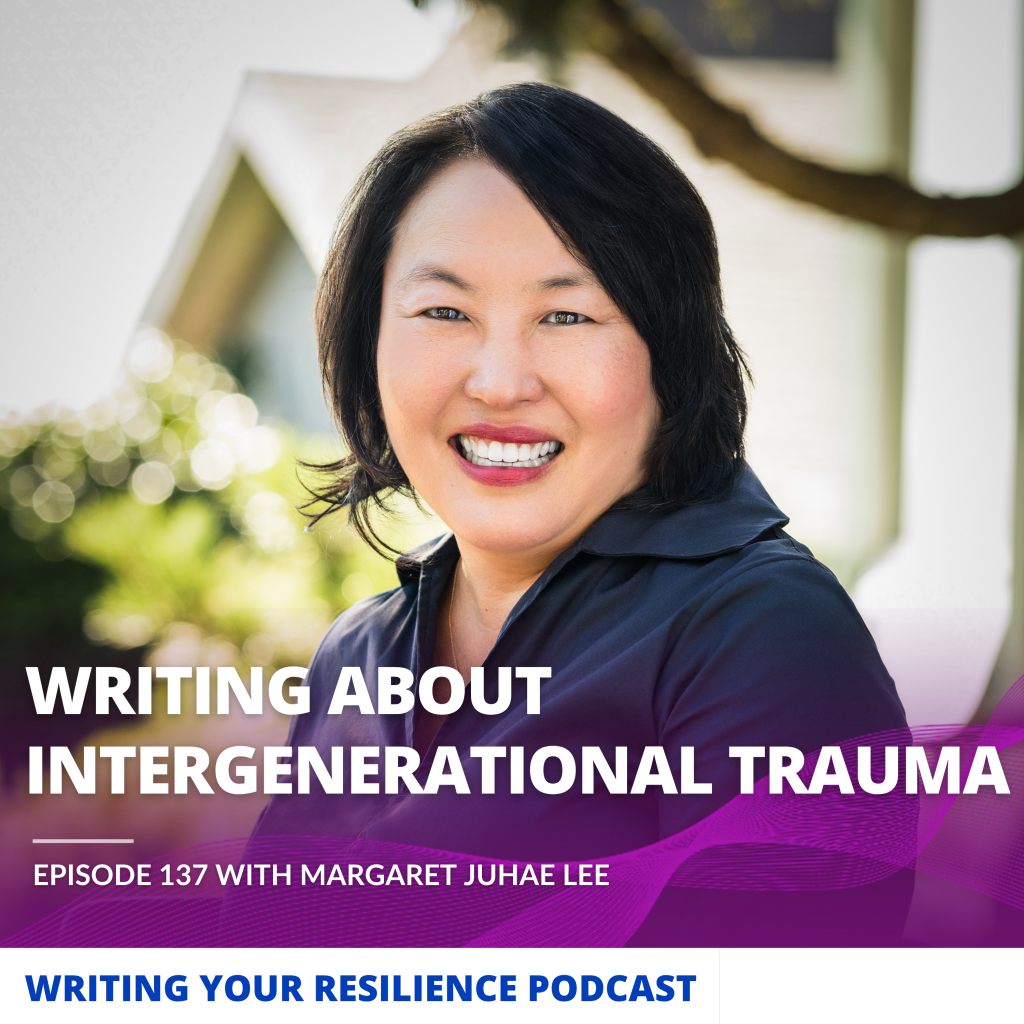
In this summer rewind episode, I revisit my conversation with Margaret Lee, author of the award-winning memoir Starry Field about how the gaps in our family history impact us. During our conversation, we explore the impacts of intergenerational trauma on our identity, the challenges of writing a researched memoir, staying motivated over the long haul, and the problem of getting an agent too soon. Her tips are as timely as ever, and you won’t want to miss what she discovered about her family and herself.


See what our listeners are saying
“I cannot say enough about the Writing Your Resilience podcast. You can tell she prepares for every episode and dives into every guest’s work with great care and preparation, always thinking of what her listeners will come away with.”

Hannah Sward
Author of Strip: A Memoir“I never view podcasts. Until this one. What a help for healing and writing. So many nuggets.”

Mark K.
Listener“I just wanted to say thank you for your podcast. It is my new self-help drug, lol.”
Anonymous
Listener from Victorville, California“I’ve been a subscriber to Writing Your Resilience for a long time now. I always walk away inspired to carry on the often difficult work of writing. Her podcast always reminds me of the power and potential of writing as a path of transformation.”
Anonymous
Jen68uhjd April 2025Transcript for Summer Rewind: Writing About Intergenerational Trauma with Margaret Lee
Listeners, I am currently on break so I can focus on my writing and some much-needed rest. Until I return with new episodes on September seventeenth, I’ve curated a summer rewind series of fan favorites. If you’re new to the show, this is a great way to start, and if you’ve been here for a while, these episodes include gems you’ll want to hear again.
In this summer rewind episode, I revisit my conversation with Margaret Lee. Since this episode aired, her memoir, Starry Field, has been named has been named a best book of 2024 by the San Francisco Chronicle, Washington Independent Review of Books and Largehearted Boy. It was also the winner of the Discovery Prize for Nonfiction by the Writers’ League of Texas. She speaks around the country about her experience and is the cofounder of Radical Ahjumma, a collective of feminist writers from the Korean diapsora,. During our conversation, Margaret and I explored the impacts intergenerational trauma on our identity, the challenges of writing a researched memoir, staying motivated over the long haul, and the problem of getting an agent too soon. Every single gem she shared is a as relevant today as it was when we last spoke. So let’s get to this week’s show.
...Lisa Ellison [0:00]
Well, hello, Margaret. I am just beyond delighted to have you on the podcast. It’s so good to see you again.
Margaret [0:06]
Good to see you too, Lisa. It’s been—it’s been a while. It’s been a couple of years, so…
Lisa Ellison [0:11]
I know it has, and I’m holding up your book, and I’m doing a huge happy dance because
we’ve been walking this journey for a long time here.
Margaret [0:20]
Yes, yes, yes.
Lisa Ellison [0:22]
And I only participated in a small part of that journey, because this book journey has been going on for quite a while.
Margaret [0:32]
Yeah, it’s been almost 25 years. I started research in 1998, and it was published in 2024, so actually more than 25—I’m bad at math.
Lisa Ellison [0:46]
That just means you’re a writer.
Margaret [0:50]
[Laughs] My husband likes to joke that it’s my first child. I have other children who are 18 and 15, but this book has been around longer than my husband, so it’s nice to see it in the world.
Lisa Ellison [1:02]
Absolutely. And I can totally understand why he would say that, why you might think that. Because I’ve read it, which everyone really should read. I have some thoughts about what I love about it, but I want to start by giving you an opportunity to let us know what you would like us to know about Starry Field.
Margaret [1:19]
I think I want to start with the title. People always ask, “What is Starry Field?” And Starry Field is a translation of my grandfather, Ichol Ha’s pen name, which is Sun Ya in Korean. That’s the name we discovered he used with his communist comrades in the late 1920s in Korea, when Korea was a colony of Japan. And when we discovered that name, I knew it had to be the title of the book. It’s so poetic, and I think it really expresses his idealism for an independent Korea—looking towards the stars. I knew it was going to be the title from the beginning.
Lisa Ellison [2:04]
Yeah, it is a perfect title. Can you tell us about the cover? Because there’s significance there.
Margaret [2:11]
So the cover is my grandfather’s actual prison photograph. It was taken when he was 19 years old in Seoul, after being arrested by the ruling Japanese for protesting their rule. He was handing out leaflets to high school students, urging them to boycott classes because they refused to teach Korean history or even the Korean language in schools. That act has so many reverberations now with modern protests. It’s just amazing to think of this teenage boy, who was my grandfather, doing that and then being in prison for seven years.
Lisa Ellison [2:53]
Yeah, I was just amazed by his courage, his fortitude, his passion—all the things he did. And your other family members as well. I mean, he’s definitely a hero in this book, but he’s not the only one.
Margaret [3:10]
No, no, no.
Lisa Ellison [3:11]
That’s one of the things I really loved about this book. As someone who grew up in the United States with an American education, we learn so little about Korea. Your book educated me on so many things, in addition to helping me fall in love with your family and your story. I mean, I was already in love with you because I’ve known you for a while, but getting to know you in this deeper, more intimate way through your memoir was just a privilege—especially your grandmother, Halmoni. I loved getting to know her. I was just thinking about the strength she had to endure everything: the colonial rule of the Japanese, the Korean War, raising two boys through all of this, and having a husband who was seen as a traitor. Oh my gosh, the courage she had to show.
Margaret [4:11]
Right? And, you know, the book is really centered on her stories that she told me. I conducted three pretty long-form oral history sessions with her when she was 90 years old, which happened to be six months before she passed away. She told me stories she had never shared before with anyone. She was a survivor. She was always looking forward, never looking back. When I started asking her questions, the first thing she did was give me the stink eye. She said, “Why do you want to know about painful things?” She didn’t understand—why would anyone want to know? She had already put that in the past. It was a real struggle to get her to talk. I said, “Well, I need to explore my identity, emotional reasons, blah, blah, blah…” and she still didn’t want to talk. It wasn’t until I said, “Halmoni, this is for my career. I’m a journalist. I’m trying to get a book published.” Then she said, “Okay, I’ll do it because it’s for your career, and you need to eat.” She was a super practical woman, and that’s what got through to her, which is so funny. But once she started talking about her life, she couldn’t stop. It just flowed because it had been inside for so long.
Lisa Ellison [5:46]
Yeah, you gave her such a huge gift. I wonder how much of her reluctance to speak was related to culture, her own coping mechanisms. I don’t know what it was like generationally in Korea, but I know in the U.S. we might talk about someone being part of the Silent Generation. How much of that generational experience affected her? Do you have any insights?
Margaret [6:18]
I think it’s definitely generational. I think many people, including my parents who lived through the Korean War—they were in high school—they never talked about the war. It was too painful. I think it’s almost up to the next generation to ask questions about that experience. Growing up, my parents would say, “Oh, I graduated college late because there was a war for three years and I couldn’t go to school.” That was their framing of the Korean War. Not that, you know, our family was displaced, people died, they saw horrible things. It was something they had to put behind them. Especially as first-generation immigrants in this country, they were just trying to survive. They didn’t have the privilege or time to look back. I think that’s common in many immigrant groups.
Lisa Ellison [7:14]
Absolutely. And, yeah, that’s such a nonchalant thing to say. “Oh, I couldn’t go to school for this period of time.” You know, just a war, no big deal. That’s something Americans can’t fathom in the same way. Other than 9/11 or Pearl Harbor, we’ve not really been attacked in this country. We don’t understand war in the same way your family does.
Margaret [7:38]
Oh, definitely, definitely. I felt that trauma in a way. When I started this book, the term “intergenerational trauma” wasn’t widely used, so I didn’t think of my story in those terms. But once I heard that term, I thought, “Oh, that’s part of what’s going on here.” There’s trauma that’s inherited and at the heart of my family’s experience. Even though they never talked about it, I could feel it. I think that’s what I was working through in this book, even though I didn’t frame it that way when I started. PTSD wasn’t really part of the lexicon in the late ‘90s, except when it came to veterans. Now, it’s used by everyone, like, “Oh, I have PTSD from this.” It’s just thrown around in our speech.
Lisa Ellison [8:23]
Yeah, and the unfortunate thing about that is when we use these words so cavalierly and casually, they lose their meaning. But your family definitely experienced severe trauma as a result of war, and I can see how that PTSD and the experience get passed down, often through the silence.
Margaret [9:10]
Oh, definitely. And, you know, that was part of my inheritance. I didn’t have family stories growing up—maybe some from childhood, but not the core of what my parents grew up with, and then my grandparents. So, my grandfather was this empty hole, and that gets passed down as this emptiness. It took me a while to realize the real reason I was writing this book. But it wasn’t until I had children that I discovered I was writing it for them, so they could have the family stories that I didn’t—or that my parents didn’t.
Now I know, reading psychological studies, how important family stories are to identity formation, and I think that’s one reason why I felt so lost for so many years, until I was an adult. I didn’t go on the search for my Korean identity until I was an adult. Like you, I grew up knowing very little about Korean history. It wasn’t taught in school, right? I grew up in Texas. No one even talked about the Japanese internment camps—that wasn’t taught in school.
And when I went to college at the University of Texas in the ’80s, there was no Asian American studies program. So, I didn’t even identify as Asian American until I moved to California. There were so few people of Asian descent when I grew up. There was only one other Korean family, one Chinese family. It was 98% white. So, I didn’t feel that identity, you know, that community, until I moved to the West Coast.
Lisa Ellison [10:52]
Yeah, and this is coming from your book. It seemed like growing up, you were almost fighting for a specific identity, like, “No, I’m an American,” because you were experiencing so many people questioning your identity and asking, “Well, where are you from? Really?”
Margaret [11:11]
Right, right, right! And that was a daily occurrence. I just did a reading in Austin. I went to UT Austin, so it was kind of a homecoming. I was staying with a childhood friend of mine, and he asked me, “What could we have done to make you feel more at home?” And I’m like, “Well, you guys were my friends, so with you, I never felt like a foreigner.”
But on a daily basis, my family and I were treated like foreigners by neighbors or based on assumptions, like, “Oh, are you guys Vietnamese boat people?” There were all these assumptions just from looking at our faces. And it was never assumed that we were American or that I was born in this country. That was never the assumption growing up.
Lisa Ellison [11:55]
You know, I’m really mindful when I’m in hotels, especially because that’s usually where I ask this question. I’ll be in an elevator with someone, and I’ll ask, “Oh, where are you from?” I’ve learned to say, “Where are you traveling from?” because if I’m in an elevator with someone who maybe did come from another country, or has had the same experience you had, I really try to be mindful to not “other” them in that way.
Yes, because I think it’s such an unconscious thing that happens, and we don’t even realize it.
Margaret [12:30]
Right, right? It’s such a loaded question for me. It’s like, “Oh, I’m from Oakland,” or “I’m from Houston,” but that’s not what they mean. Now, I think it’s a little bit different, but back then, that’s not what they were asking. They were not asking the question they wanted the answer to. They could have said, “What is your cultural heritage?” rather than just assuming “Where are you from?” means you’re from a foreign country.
So, exactly, yeah. Super loaded question. Almost every Asian American person I know hates that question, or anyone from a different country or immigrants.
Lisa Ellison [13:09]
Because they aren’t asking you a direct question related to their real curiosity, which is an inappropriate curiosity. I mean, unless you have some reason for needing to know that, and you’re having a thoughtful conversation, most of these questions are not coming from that space.
Margaret [13:28]
No, not at all.
Lisa Ellison [13:30]
It’s just trying to figure out, “Well, where do you fit within my paradigm of how I see the world?” And that’s not useful.
Margaret [13:38]
No. And it was interesting, when I lived in Minneapolis—I lived there for a year—I would get questions like, “Oh, are you adopted?” because most of the Asian people these white people came across in Minneapolis were adoptees from Korea or Japan. So, I got that a lot. I’m like, “You know, that’s not really a nice question to ask someone that you don’t know.”
It’s like, what kind of assumption is that? Yeah, it’s just interesting. And maybe it’s because I’m in the Bay Area, I don’t get those questions anymore.
Lisa Ellison [14:15]
Well, good.
Margaret [14:16]
Yeah, yeah. Maybe it’s progress, or maybe it’s just where I am. So, yeah, I’m going to hope for progress for all of us.
Lisa Ellison [14:29]
If you’re listening, and you’ve found yourself doing this, you’re like, “Oh my gosh, I think I’ve done this in the past,” here’s a great opportunity to think about it in a different way and change your behavior, right? You can just do something different and interact with people in a different way.
Really be mindful that these questions are not helpful, and in fact, they can be very hurtful to people because it makes people feel separate. So, getting back to this book, which took you 25 years— that’s like an adult child. I mean, you raised this child, launched this child, quite literally. And I know that one of the questions everyone’s going to have been, how did you maintain your focus, motivation, and tenacity over that length of time?
Margaret [15:19]
I mean, there are definitely, you know, chunks of years where I had to put it away, mostly for caretaking reasons, when my children were little. And, you know, there were many instances where I thought I was going to quit, because when I started this book, I was a journalist in New York. I was working at The Nation magazine. I got a fellowship, a very prestigious fellowship, at Harvard, and I got an agent right away in the late 90s. And I got an agent way too soon before I really knew what this book was about. I thought this book was a book of journalism because that’s what I was, and that’s what I knew how to write.
And when I sat down after I went to Korea to look for my grandfather’s records and interview my grandmother, I came back to the U.S., and I sat down and tried to write it. I realized that journalism wasn’t going to capture the entire story, and, as a journalist, I wasn’t comfortable writing about myself because that’s not what they teach you in journalism school. So that was a big, big struggle for me.
I worked with my agent, and then he left the business, which I think was a blessing. At the time, I was kind of devastated because I thought, like, “Oh, this is the next part of my career, you know, I’m going to get a book deal.”
But I think it gave me the time to gain the skills to write the book I wanted to write, and it took a while. I really read fiction. I read a lot of fiction in a very critical way. I looked at scenes; I looked at dialogue. Then I met my husband, started having kids, and I put it away for a while. When I came back to the book when they started going to preschool, I started taking generative writing workshops because I was stuck and didn’t know how to approach all this research. I’d done all these interviews with my grandmother and my great-uncles, and I had all this stuff, but I didn’t know how to figure out how to edit it on the page.
This generative writing workshop was the best thing for me, because I’m an editor. I self-edit way too much, and I was forced to write in longhand in a community, feeling very held and safe. And what came out was my book. I didn’t have my notes or any of the research, but the research had permeated, and I could figure out the story. So that’s the kind of short version of that part of the journey. I did have to put it down again. I had a pretty good draft. I had sent it to an agent. She said, “You know, I’m very interested. I think there are some issues here.” And she was totally right. But then, I was working on a new draft, and my parents, both of them, became ill. So, I was also caretaking.
Lisa Ellison [15:29]
And so what I want people to hear is, it’s not like you worked on this the entire time. No, you worked on it, you took breaks. You worked on it. You had so much research, and that is clear in this book because we see photographs of different things. And what I love about this is that you were in this generative writing group where you had to let that go. And I often tell people when they have lots of research—I don’t know if this was your experience—but a lot of the clients and students I work with get very attached to the research, because you had to work hard. And so, you want to put everything in the book, and that’s not useful.
I’m going to open this just to get the page numbers. Yeah, this is a nice, lean book, especially given how much research is in it. I mean, it’s 265 pages, going to the Epilogue, and so you had to do a lot of weeding, a lot of culling. You had to figure out how to tell this story, knowing that it’s all inside you. And we’re going to talk about the structure in a moment. But you said something that caught my ear, and I know it’s going to catch everyone else’s ear. You said, “I got an agent too soon,” and that’s something you learned in retrospect. What would you like people to know about that process and what you learned?
Margaret [19:28]
I learned that, you know, I felt very validated when I got an agent. Actually, I had a couple of agents interested in what I was working on, but I didn’t have enough written. I didn’t have a conception of the book. If I had published a book in 2000 or 2002, I don’t think I would have been happy with it. And if I had gotten a contract, I would have been required to finish by a certain time. And I know myself—I’m a journalist; I always follow deadlines—and I would have given them something. I think maybe a novelist would take longer and think, “Oh, creatively, I don’t know if this is right.” There are plenty of people who get contracts and never finish their books, but I’m glad I wasn’t in that scenario. I think I would have felt really guilty if I had gotten that far.
But it was really, really hard. I was kind of devastated, and I really had to shift gears. I had to get a real job and do journalism, patching together paying jobs. But it was really hard, though it turned out to be a blessing. You know, 20 years later, because this is my family story, I don’t want to mess it up. I knew that deep inside.
Lisa Ellison [21:48]
Yeah, I’m glad you just said that because so many people get impatient. They want to hurry up and get it out because they think somehow, it’s going to lead to whatever the next great thing is, right? And maybe it will, maybe it won’t, but one thing that can definitely happen is that if you haven’t taken time to really process and understand your story and tell it in the best possible way, there are no re-dos.
Margaret [21:48]
Right, right, right.
Lisa Ellison [21:48]
Yeah, I’m not with these.
Margaret [21:48]
Yeah, yeah, yeah. It was a journey, but I feel good about it, and I think it honors my family. I’m happy to have my kids read it, and that’s a victory. Also, it helps to be incredibly stubborn.
Lisa Ellison [21:48]
Yes, stubbornness is a huge asset when you’re a writer, right?
Margaret [21:48]
Right. And I’m so glad that I was stubborn because this book is amazing.
Lisa Ellison [24:17]
As I was reading this and following your research journey—because that is part of what we do, follow some of that research—I was just thinking, “How did you do this so elegantly?” We were together in 2019 at the Writers Hotel Conference, and I got to read a portion that I believe at that time was called the beginning, right? And as I was reading, I was like, “Wait a second, I see these pages in the middle of the book.” When you were in the later stages of the writing process, how did you go about structuring this book, and how did you know this structure was the right one?
Margaret [19:28]
Structure was the biggest challenge in this book. I have three main characters: me, my grandmother, and my father, and in the background, my grandfather. Even though he’s not quite a character—only a handful of people knew him—you know, it spans 100 years. It’s a very complicated story, and I knew I couldn’t present it in a traditional narrative form because it didn’t work. I didn’t come up with the structure until I finished my book proposal. There were a lot of index cards, using whiteboards. I knew that my grandmother’s oral histories, which pertained to certain points of her life, were the pillars. And I think it was my agent who really distilled what was important, which was my grandmother’s story. She was my conduit to the past.
I organized the book with these different parts of my grandmother’s life, and my childhood, my father’s childhood, and the middle part—her marriage. Then, at the end, when she had children. So, there was a lot of shuffling. It was like putting a jigsaw puzzle together, literally.
Lisa Ellison [19:28]
I definitely felt that. And yet it felt like a complete puzzle.
Margaret [19:28]
Yeah, yeah. I think it finally fell into place when I could state what the structure was. Before, it kind of worked and flowed, but it wasn’t quite right. I really credit my agent for being an amazing editor and helping me with that.
Lisa Ellison [24:17]
Yeah, I bow to her because I know how much she helped you with this in terms of thinking through these things. Yes, and that’s important, because a lot of people don’t realize structure is a team sport, especially when you have researched work and a complicated story like yours, spanning 100 years. I know some people are just trying to write about their life, and they’ve got 50–75 years they’re trying to write about. Knowing how to skip, move around, create something that feels like a cohesive arc is important. Two arcs that I see are your grandmother’s arc of transformation and your arc, and then your father’s arc as well, because he didn’t know anything about his father.
Margaret [25:15]
Right, right. And the discovery of my grandmother’s stories—and that my grandfather was a leader in the movement—it totally changed him. He became a different person once he knew. He always carried the shame of being the son of a criminal. On my parents’ first date, that was one of the first things he said to my mom: “You know, I’m the son of a criminal.” My mother would tell me the story, like, “I thought your dad was kind of kidding, so I just kind of ignored that and moved on with the conversation.” But I was thinking about, like, my poor dad, feeling like he had to confess to this woman, who would be my mom, right up front, so she would know, “Hey, I’m tainted goods.” But once he found out, it was like a weight lifted off him. He became gregarious, huggy—he was not the father I grew up with. He became maybe his true self, you know?
Lisa Ellison [26:15]
That’s the miracle of this process. It’s not so much about the finished product, which I know your dad would be so proud of you. He is so proud of you. I believe that 100%. Just the fact that you went through this process, and he was hearing all of this, transformed him, right?
Margaret [26:39]
And that was, you know, maybe one of the biggest gifts for me: to really get to know who my father was and understand him. Because when I was growing up, he was very quiet, very stern, and did not show his emotions. My mother, who was a painter, was always translating my father to me and my brother. It was like, “Well, your father’s very happy about this and this.” And we’d be like, “Okay,” you know, because he didn’t feel comfortable expressing himself. Once this revelation happened, he realized, “Oh, this is where I come from.” My grandfather was an intellectual. He was reading Marx, he was reading Lenin, and he was reading novels by Thomas Hardy. That’s something I found out from the reading list of every book he read in prison because the Japanese were amazing record keepers. My father always felt like the weirdo in his family. He was the first one to go to college; he was the egghead. He wasn’t like his brother or his cousins, and he always felt very different. Learning who his father was made him realize, “Oh, that’s where I get my interest in sociology and math and all these different things from.”
Lisa Ellison [27:52]
Yeah, because he was following in his father’s footsteps; he just didn’t know it.
Margaret [27:55]
He didn’t know it, yeah.
Lisa Ellison [27:57]
And at that time, you said he was reading Thomas Hardy. Was he reading a Korean or Japanese translation, or was he reading an English version? Because I know that they were required to learn Japanese, right? Were they learning English at that time, or was this just some remarkable thing that he did?
Margaret [28:15]
I’m guessing it was in Japanese. I don’t know if my grandfather learned English. I think these were translations into Japanese or Korean, most likely Japanese. But, yeah, I mean, he was interested in Thomas Hardy; maybe he just read it because it was there. But it’s just odd that at the most notorious prison in Seoul, reserved for political prisoners, they had books by Thomas Hardy, and they had science books and math books and all kinds of things.
Lisa Ellison [28:55]
So yeah, that is remarkable. I wouldn’t think that that would be there because I would almost imagine, if I oversaw the prison, I would want them to have less information, right? You know, less capacity to think about all the things that they might want to do. And yet, what a gift that he had access to all of that and was able to take it all in.
Margaret [29:19]
Yeah, yeah, that’s amazing.
Lisa Ellison [29:23]
So structure was one of the things you had to deal with. And then you talked about being a journalist and the challenges of that. I have worked with many what I call journalists in recovery—yes, they want to write memoir or things that are more narrative, where they have to be the character. You have this wonderful background that helped you with all the research when you started writing your story. What of your journalistic background did you keep, and what did you have to scrap in order to truly write your story in a narrative way that would hook the reader and keep them hooked?
Margaret [30:03]
I think journalism really helped with gathering details about scenes and being the observer. You know, the journalist is usually writing in the third person, so that really helped in capturing the milieu wherever I was and having the resources to know how to research that too. Now everything’s online, but when I started, I had to go to libraries. It was a different approach, but I knew how to find the information. What I had to unlearn was that observational point of view. I had to be the motor, and that was so difficult because I am way more comfortable writing about other people. I had to unlearn those strict edicts from journalism—no “I” in journalism—and look to fiction more. Not be so concerned about whether everything I say is true, because there are different points of view. This is what my grandmother said, I don’t know if all of it’s true, but it’s what she said or her version of the truth. I have other interviews with great uncles, one who is notoriously not a good source. My father said, “I don’t believe anything he says.” But I was interested in what he said because part of it rang true to me. Also, the freedom in memoir to say, “This could have happened. This is what someone says,” and not be overly concerned with what is the truth in the big T kind of way. That was very freeing for me because memoir writing is not just truth writing or what is perceived as truth. It’s not journalism where you must get all the facts right. You do have to get the facts right, but you have the freedom to say, “This might have happened,” and give the reader the choice: “What do you think?” So that was a big breakthrough for me, to put in the text, “You know what? This person’s not the most reliable, but this is what they said.”
Lisa Ellison [32:24]
Yeah, I love that you gave yourself the permission to do that and to let go of some of the things that you were trained to do. Memoir is about emotional truth, right? Sue William Silverman, one of my guests, talks about how we don’t want to Xerox our stories, right? It’s not a Xeroxing of the life events that happened. Yes, it is an ordering and curating so that we can get to an emotional truth, which may or may not be different from the actual hard facts because we’re looking at recollection and points of view, all of which you shared so beautifully. So, writers, you need to listen to everything Margaret says, and then you need to go buy her book to see how she was able to pull that off. I really felt connected to you. And I was thinking about, okay, I know you, we’ve had lots of interactions over the years. How much of that sense of connection and closeness is related to me knowing you personally, or how much of it is the story? I definitely feel like the way you wrote this—the vulnerability, the openness, the way that you navigate your scenes, and just even talking about your young life and the bands you liked and the raves you were at—all those things made me trust you and gave me a sense of who you were and who you are. I was really grateful to the book for that. You’ve been on book tour for a while now. People have been asking you lots of questions. What’s a question that nobody has asked yet, or one that you’re like, “You know what? Please ask me this. I want to answer it.”
Margaret [34:15]
Oh, you know what? I thought people were going to ask about my New York boyfriend in the book, which I really struggled writing about because it was so essential to the story, but no one has asked about him at all. So, it’s interesting to me, like, “Oh, okay, maybe that wasn’t as important as I thought it was.” What sent me on this journey was that I was searching for my identity after breaking up with this boyfriend who had some severe mental health struggles and didn’t want to deal with them. That was kind of the space I was in when I started this journey. Part of the arc of the book is that I’ve always wanted kids from the beginning, in my 20s. It was always this urge, and I had horrible taste in men and did not know how to figure out a way to have kids. I didn’t end up having kids until I was in my 40s, so I waited a long time. Also, I was moving around a lot and didn’t feel like I was at home anywhere. There was always that urge, and I think I realized that I needed to clear the way for myself to search for my identity and figure out what happened in the past before starting a family of my own.
Lisa Ellison [35:44]
Yeah? So that intuition drove you, as well as those Spidey senses like, “This is not the one,” right? And I mean, as you were talking about this boyfriend, I’m like, “Oh yes, I know exactly what you’re talking about.” The stories are written in a very colorful way. You bring him to life so well. But as you’re talking about it now, and as I was thinking about it while reading, I think about that Vivian Gornick statement about situation versus story, right? Part of the situation, like the background that needed to happen in order for the true story to take place.
Margaret [36:21]
And that book was so, so influential on me because I was stuck in the situation. You know, all my research, all the facts—I needed to explain Korean history and all this stuff. Getting to the story was the hard part for me because I had too much information, and I needed to be free from that. I think having time away and not being immersed helped me figure out the story. I needed that break, I think.
Lisa Ellison [36:53]
Yeah. Was there something that created the big breakthrough for you? As we’re moving towards the end, I mean, I miss you. Margaret, can I just say that I miss you? We haven’t seen each other in a little while, no tour. So, we’re going to catch up later at another time. But I think this is a nice segue into thinking about the best writing advice you have or a breakthrough you experienced. You had to transition from situation to story, and I’m wondering if anyone said anything, or if something happened that created that breakthrough for you.
Margaret [37:31]
I think just writing off the top of my head was the best way for me to figure out the story. Having a prompt helped. The first prompt that really spoke to me was to think of a photograph that is really important to you and write to that photograph. The photograph was of my grandfather, his prison picture, which is on the cover. It was the only photograph we had of him. So, I wrote to that photograph without going into details like, “Oh, this is from 1929” and providing the facts about it. I focused on what the photograph meant to me. Here is this young boy who looks a lot like my brother, who was about the same age when we found the photograph, and that was the artifact we had of this man that no one ever knew.
Lisa Ellison [38:25]
Yeah, the resemblance is uncanny.
Margaret [38:27]
Yes, it is pretty amazing.
Lisa Ellison [38:30]
And I know this because you include so many photos of your family in the book, which was truly a gift. I’m curious—one of the things that happened as you were working on this book was, unfortunately, both your parents passed away, right? I was speaking with another writer about what happens when we step away from our manuscripts because of grief. I know a lot of people who have to do that because they don’t have the energetic space for both. When you came back to this manuscript as a new person because of your experience, was there anything about that that allowed you to see the story in a different way?
Margaret [39:12]
I wrote the Prologue and Epilogue after my parents passed away, and they are about grief. We took my family to Korea and scattered my parents’ ashes there. I think those were the perfect bookends to this book because most of it is set in 2000, which is 25 years ago. Having that bookend works by bringing the present into the past—my present self as a mother of two kids, a settled person with a home in Oakland, and a husband and family.
Lisa Ellison [39:57]
Yeah, and your kids are great in the book. I agree with you 100% that the Prologue and Epilogue are a perfect way to work through this and set us up for it. So, you’ve been on book tour for a while now, a few months, since the book came out in March, correct?
Margaret [40:24]
Yes, right.
Lisa Ellison [40:24]
Right. So, how have you been nurturing your resilience during what is often a really grueling time for people?
Margaret [40:24]
I’ve really focused on going to places where I have friends. I was just in Austin, where I spoke at the Writers League of Texas Agents and Editors Conference. It was a great conference, but I went to school at UT Austin, so I stayed with my childhood friend. I did a reading, and I had all these old friends I hadn’t seen in 30 years come. That’s how I nurture myself. I also met new writers. Even though it’s exhausting, I try to view these events as opportunities to connect rather than just focusing on selling books. I’ve gone places like New York, where I used to live; Portland, where my brother lives; and Seattle, where I have many writer friends. I’m really trying to use the book tour and speaking engagements to connect with people. In Austin, I was surprised when one of my parents’ oldest friends from Houston drove up with his son. They drove two and a half hours to Austin just to see me. It was so touching. And then in Amherst, I saw a Korean family and thought, “Oh, look, there’s some Korean family; there aren’t many Koreans in Amherst.” It turned out to be my cousin Robert, whom I hadn’t talked to in over 20 years. They drove all the way from upstate New York, so those have been some amazing moments.
Lisa Ellison [41:53]
I think that’s really smart and very beautiful. What I’m hearing is that you recognize that the book tour and all the associated tasks are draining, and yet you’re being intentional about finding ways to fill your cup by connecting with people—either creating new, meaningful relationships or rekindling old ones. That’s an incredible thing to do, and not focusing on book sales is wise because it’s easy to get disappointed by the numbers. Even if they meet expectations, there’s always a new goal to set.
Margaret [42:43]
Right. And, you know, book sales—I still don’t know how many books I’ve sold. My agent says I’ll find out in my royalty statements. I get two royalty statements, so we’ll see. But I’m trying to focus on what I want to get out of this book. I really want to speak at colleges because I would love for this book to be taught in Asian American Studies classes. This is the book I would have wanted to read as a young person. It’s also for my children and their generation. That’s the audience I really want to reach for the future.
Lisa Ellison [43:19]
I’m super excited about that for you. I can’t wait to hear in the near future that this is actually happening. There’s so much we could discuss about this book. To end, I’d like to encourage everyone to buy the book and review it because Margaret has worked so hard, and all those reviews are really helpful to the author. So don’t forget to do that. If people want to buy Starry Field, I’m going to hold it up again for those watching on YouTube. What are the best ways to buy your book and connect with you?
Margaret [43:55]
I have a website: www.margaretjuhaelee.com. I’m also on Instagram at @MJuhae. Please buy your book at your local independent bookseller or on bookshop.org. You can buy it wherever you want, but I won’t mention those places. Feel free to review it; it is very, very helpful. Yes, you can reach me on Instagram. That’s something I’ve learned—how to be my own social media manager. I got many lessons from my teenage children. I’m very thankful to them.
Lisa Ellison [44:32]
Kudos to your teenage children because, yes, we all need these tutorials, and they seem to know everything. Well, Margaret, it’s been an absolute pleasure both to read your book and to see you today and celebrate this momentous occasion of your book launch year and all that you’re doing. I’m so grateful to you and to this book, which I think everyone should read. So, one more shout-out: as you’re buying and reviewing, consider ordering it from your library so that those who need to read it but may not have the funds have access.
Margaret [45:09]
Yes, thank you so much, Lisa. It’s been a pleasure talking to you.
Show Notes for Summer Rewind: Writing About Intergenerational Trauma with Margaret Lee
About this episode: In this summer rewind episode, I revisit my conversation with Margaret Lee, author of the highly acclaimed memoir Starry Field. In it we explore the impacts of intergenerational trauma on our identity, the challenges of writing a researched memoir, staying motivated over the long haul, and the problem of getting an agent too soon. Since recording this episode, Starry Field has been named a best book of 2024 by the San Francisco Chronicle, Washington Independent Review of Books and Largehearted Boy. It was also the winner of the Discovery Prize for Nonfiction by the Writers’ League of Texas.
Episode Highlights
- 4:00 Why Explore the Past?
- 7:00 The Impact of Intergenerational Trauma
- 9:00 The Role of Stories in Identity Formation
- 15:00 Maintaining Your Momentum Over the Long Haul
- 20:00 Getting an Agent Too Soon
- 22:00 Structuring a Researched Memoir
- 26:00 The Miracle of the Memoir Process
- 29:00 Turning Yourself into a Character
- 35:00 Understanding Situation versus Story
Resources for this Episode:
Margaret’s Bio: Margaret Juhae Lee is an Oakland-based writer and a former literary editor of The Nation magazine. She has been the recipient of a Bunting Fellowship from Harvard University and a Korean Studies Fellowship from the Korean Foundation. She is also a Tin House alum and has been awarded residencies at the Mesa Refuge, Anderson Center, and Mineral School. In 2020, she was named “Person of the Year” by the Sangcheol Cultural Welfare Foundation in Kongju, South Korea, for her work in honoring her grandfather, Patriot Lee Chul Ha. Her articles, reviews, and interviews have been published in The Nation, Newsday, Elle, ARTnews, The Advocate, The Rumpus and Writer’s Digest.
Connect with Margaret:
- Website: www.margaretjuhaelee.com
- Instagram: @mjuhae
- Twitter: @margaretjuhae
- LinkedIn: https://www.linkedin.com/in/margaret-juhae-lee-2b95905/
Connect with your host, Lisa:
- Get Your Free Copy of Write More, Fret Less: https://lisacooperellison.com/newsletter-subscribe/
- Website: https://lisacooperellison.com/
- Instagram: https://www.instagram.com/lisacooperellison/
- YouTube: https://www.youtube.com/channel/UColPDzpoQlVktIv7-f7ObRg
- Facebook: https://www.facebook.com/lisacooperellison/
- LinkedIn: https://www.linkedin.com/in/lisa-cooper-ellison-b5483840/
Produced by Espresso Podcast Production: https://www.espressopodcastproduction.com
Get the latest episode delivered to your inbox!
About Your Host
Lisa Cooper Ellison is an author, speaker, trauma-informed writing coach, and host of the Writing Your Resilience podcast. Working at the powerful intersection of storytelling and healing, she blends her writing expertise, clinical training, and soul-centered practices—including Akashic Records work and Human Design—to help writers turn their hardest experiences into art. Her essays—on sibling loss, grief, trauma healing, and the craft of writing—have appeared in The New York Times, HuffPost, and The Loss of a Lifetime: Grieving Siblings Share Stories of Love, Loss, and Hope among others.