Have you ever written something about your childhood that felt personally rewarding, but didn’t quite connect with readers?
Did they like some parts of your writing voice, but not others? Are you struggling to capture a very young narrator’s voice while imparting your adult wisdom? And if you’re writing a coming-of-age memoir that spans decades, how do you know whether the problem is related to your writing voice or if you’re starting in the wrong place?
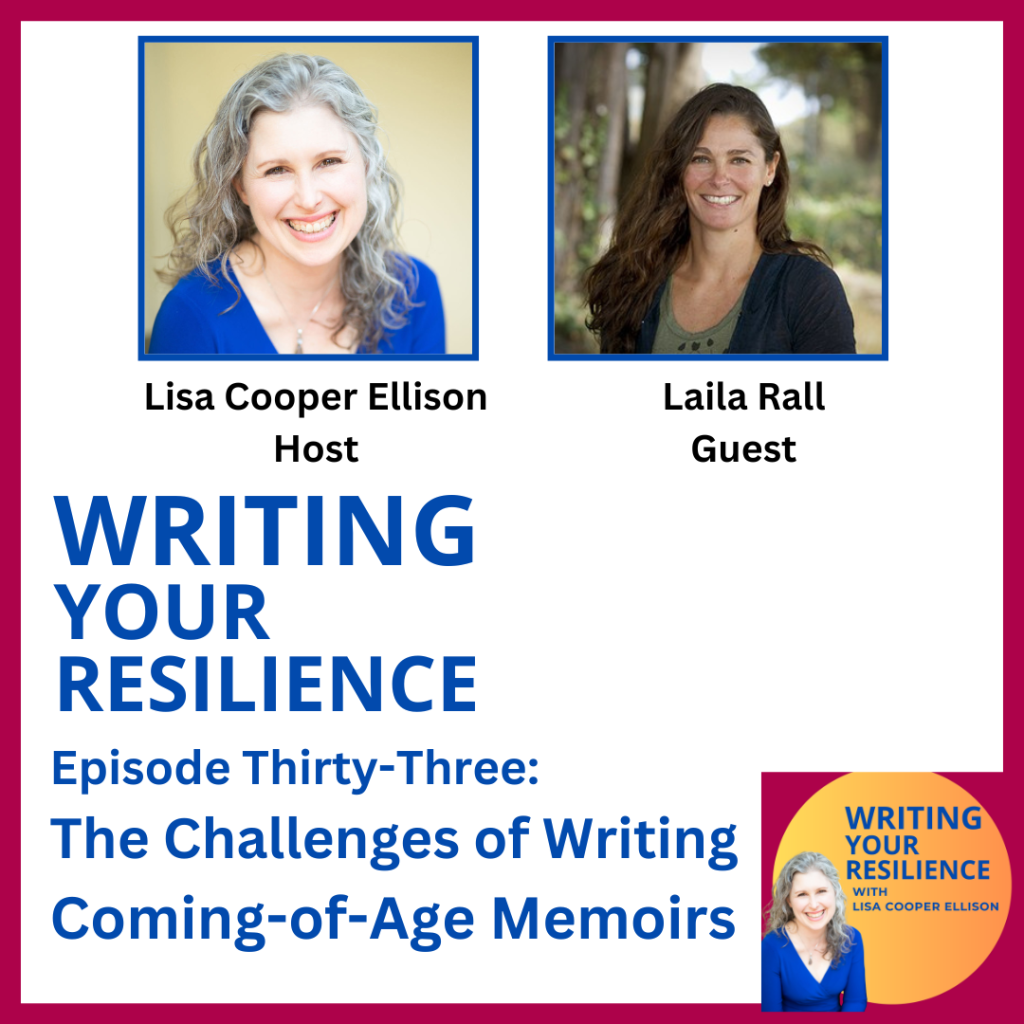
These are some of the questions I’ll explore with Laila Rall, a writer working on a memoir about her chaotic bicultural childhood with an unstable mother. As we explore two of the biggest challenges writers of coming-of-age memoirs grapple with knowing where to start and inserting adult wisdom into childhood scenes that involve very young narrators, let’s go ahead and dive in.
Transcript for Laila Rall Episode
Lisa [0:00]:
Well, hello, Laila, welcome to the Writing Your Resilience podcast. I am so happy to have you on today.
Laila [0:04]:
Hi, Lisa. I’m really excited to be here. Thank you for having me.
Lisa [0:08]:
Well, I’m honored because you are a member of my newsletter community, which is amazing. I love getting to interact with my newsletter followers in this way. While I often feature more established writers, people who’ve already published books, I think it’s important to hear from those who are still in the process, like you. So, before we get to your question, what would you like us to know about you and your project?
Laila [0:35]:
I’ve been a teacher for almost 15 years, which has been my passion and joy. I love working with students, helping them find their voice, and their place in the world. This year, I’m taking a sabbatical to find my own voice and focus on my writing. I’m working on a memoir about my unconventional childhood with an unstable mother and the aftermath of that. I’m excited to share that it is taking shape and there’s light at the end of the tunnel.
Lisa [1:05]:
That is always exciting when you see the light at the end of the tunnel. How long have you been working on this memoir?
Laila [1:12]:
I started writing 30 years ago, but that was more private writing that helped me figure out some of the issues I was dealing with and the messiness of life. It has taken different shapes since then.
Lisa [1:27]:
I know all about that. It takes so long, especially when you’re writing memoirs. I tell people this all the time: fiction has its own challenges, that’s for sure. But when you’re writing fiction, you get to make things up. When you’re writing memoir, you’re truly trying to describe your face without looking in the mirror, and it takes so much more time. So yes, 30 years—that makes total sense to me, and I love that you’re finding your voice. It seems like voice is a little bit related to the question you have.
Laila [2:04]:
Yeah. What I’ve been struggling with is how to gracefully, artfully incorporate adult reflection without interrupting the child narrator and the scene.
Lisa [2:20]:
Yeah. When we think about the scope of your book, what age does it start at, and what age does it end at?
Laila [2:29]:
There are scenes that start as early as when the character was four. There could be a discrepancy of ages spanning 30 years.
Lisa [2:40]:
That’s a long period of time. I think a lot of people writing about childhood find that a huge struggle because reconnecting with that part of oneself can be extremely satisfying. It’s just a different voice, and it can be fun to read. Sometimes you get feedback that’s helpful, but then you might get attached to that voice. I’m wondering, what feedback have you received when you’ve shared pages with writing group members or in a workshop?
Laila [3:17]:
Some of the feedback I’ve gotten is that they really like the adult reflection. They also love just being on my shoulder and experiencing things as a four-year-old, a six-year-old, or an eight-year-old might. What I’m hearing is that both are important and valuable, so I want to include both but in a way that isn’t clunky and doesn’t disrupt the narrative.
Lisa [3:49]:
Yeah, that can be so tricky, especially when you’re writing about very young children. As you think about this—and know that whenever we’re in the process of figuring it out, “I don’t know” is a perfect answer, regardless of how skilled or experienced you are. Do you feel like this is a coming-of-age memoir?
Laila [4:13]:
Yes, absolutely.
Lisa [4:15]:
If it’s a coming-of-age memoir, it’s about going from naivete to awakening. Sometimes that happens in childhood, though Suzette Mullins was on the show recently, and hers is a midlife coming-of-age memoir about understanding her sexuality. So, the idea of coming-of-age can happen at different times in our lives, but most commonly, it’s exactly what you’re talking about, which is childhood. So, the question becomes, how do you marry these two things together? A four-year-old might be wise and street-smart in different ways, especially if they’re in a situation where they have to survive—I know a lot about that—but they don’t have the cognitive reasoning to make sense of things. You, as the writer, must hold space for the meaning-making. There are a few different ways to go about this, and I’m going to name a bunch of books. If you’re listening and thinking, “Wait, I might miss some of these books,” don’t worry—it’s all going to be in the show notes. Just relax; it’s in the show notes. I have this giant pile next to me, and we’re going to talk about how you do this.
One of the first things you want to think about, especially with really young narrators, is: Are you starting in the right place? You may or may not know the answer to that. Sometimes the answer is yes. For instance, Jeanette Walls’ book The Glass Castle begins at age three. That was the perfect age to start because it begins with a high-stakes moment when she is burned while cooking hot dogs. It also shows the unbelievable nature of the life she was living even at age three. However, sometimes these early formative experiences work best as a flashback. So that’s one of the first things to consider: Are we starting in the right place, especially when your memoir spans decades? Anytime a book spans decades, that’s a red flag to ask, “Am I starting in the right place?” and “How am I going to use time in such a way that I don’t end up with a 180,000-word tome that neither I nor a reader can get through?” I see you nodding. Do you want to say something about that?
Laila [6:49]:
You’re absolutely right. I think that is the challenge: dealing with so many years and deciding what should go in, what should not be included, and where to start. Starting in the right place is crucial, so I’ll be looking at that.
Lisa [7:06]:
It’s so important and also so difficult to see. A tool I often suggest is the beat sheet. I recently taught something for Jane Friedman on this. Applying a beat sheet to your story might help you get a sense of what exactly you’re trying to say, like, “What is the arc of transformation?” and “What is the latest point in your life when that begins?” I’m not talking about a year before, but maybe not at four. So that’s one thing to think about: Are you starting in the right place? But if the answer is yes, then the next question is: What voice do I need to use to reconcile the things that the writer at her desk (the voice of experience) needs to share versus the character going through things on the page?
There are a few different ways to think about this, starting with writing with wisdom versus reflection. Writing with wisdom means every sentence you write is infused with the adult narrator’s and writer’s wisdom. For instance, even though you’re writing a four-year-old character, the meta of all this is that we know an adult is writing this. There are a few different ways to achieve this. One is through a prologue. Sometimes having a prologue at the beginning of your book can signal to the reader, “Hey, you might read about me at a younger age, but don’t forget, adult me is writing this book.” The Glass Castle has a prologue, and that’s one way to do it. So, consider whether you need a prologue. But not every book has one. For instance, This Boy’s Life by Tobias Wolff does not have a prologue, nor does Autobiography of a Face by Lucy Grealy. So, you don’t necessarily need one, but you do need to convey that an adult is telling the story.
Let me give you a couple of examples of writing with wisdom. In Autobiography of a Face by Lucy Grealy, a great book about her experience of having cancer that resulted in a significant facial disfigurement, she uses tense and word choice. Here’s an example from the prologue of her book: “My friend Steven and I used to do pony parties together. The festivities took place on the well-tended lawns of the vast suburban communities that had sprung up around Diamond D Stables in the rural acres of Rockland County.” Sometimes, when we write a very young narrator, we might be inclined to write in the present tense because it feels very alive, but sometimes the past tense can be more effective.
Mary Karr does some great work in her memoir, The Liars’ Club. In chapter one—she doesn’t have a prologue—she writes, “My sharpest memory is of a single instance surrounded by dark.” Bam. We know right away that an adult is sharing this, and we are entering memory. Then she goes straight into the scene: “I was seven, and our family doctor knelt before me where I sat on a mattress on the bare floor. He wore a yellow golf shirt, unbuttoned so that sprouts of hair showed in a V-shape on his chest.” She gets us right into the moment, but that first line elegantly tells us that we’re writing with wisdom.
Laila [11:31]:
That’s great. I’m really looking forward to reading these books and looking at the specific examples that you’re talking about and seeing how I can apply that to my own writing.
Lisa [11:41]:
Well, wonderful. So, I have—these are some good ones. And then I want to talk about reflection. So, what is the difference between writing with wisdom and reflection? When you’re writing with wisdom, you are holding space in every sentence for the fact that an adult is writing this, no matter the age of the character in the scene. Word choice and tense can help with that, and even the phrasing you use.
A way to figure this out might be to take a couple of these books and handwrite the openings, noticing the choices the writer has made that help us understand this is writing with wisdom. Reflection is the thing we are all told we need to do, and yes, your memoir very much needs that at times. But here’s the difference: when we’re reflecting, we are letting the reader know that the writer at her desk has something to say to the effect of, “Dear reader, now that you have read this excerpt of my life story, let me tell you what you need to know.”
Sometimes, people will try to do this in ways that are not elegant, and they tend to get us in trouble, especially if there is a big discrepancy between the young narrator on the page and then suddenly this adult is chiming in. A prologue tends to help with that, but it’s not the only thing you need to do. Some books have almost no reflection, and that is a choice you can make. Does it always work? No, but I’ll give you two examples that have very little.
The Glass Castle has zero reflection. There is a prologue and an epilogue that kind of frame the story that’s really in the adult space, outside of story present. The rest of it is, “Here’s a story, and let’s go.”
Laila [13:40]:
Wow. I didn’t realize that. I’ve read it, of course, but yeah.
Lisa [13:44]:
Yeah, read it again, and you will see zero reflection. But she writes with a lot of wisdom. We feel like an adult is pulling us through a story, and it’s very much a story. She’s very in control of that, and it’s very easy to create a beat sheet around this book because it’s clear that she is in control of the story.
Tobias Wolff’s book, This Boy’s Life, was written around the same time, in the 1990s. There’s one main line of reflection in the whole book. He writes with wisdom, and you can tell this is not a child writing this—it’s an adult looking back. But you also feel the child. That’s the art form. You feel the child, you’re with the child, but an adult is holding space for this. He has one line about three-quarters of the way through the book—I’m going to paraphrase it because I couldn’t find it right away—but he’s recognizing that his father has abandoned him. It’s not even a flashback; it’s a flash forward. It’s a time in his adult life when his first child is born, and he’s holding this fragile baby, and he cannot understand how his father could have abandoned him like that. That is a moment of reflection, and it strengthens what’s going on around it. So those are two books with very little reflection.
Sometimes people will call things out, especially if somebody else remembers it in a different way. Mary Karr’s book, The Liars’ Club, is really good at doing that. There’s a place early in this prologue where something is happening with a doctor and the police because there’s been a major crisis in the family. She remembers it one way, and then she’ll say, “My sister Lecia will tell you a different story.” She kind of calls it out, and the way she does this allows her to add in other kinds of reflection that let us know more about these characters.
So, those are some general, artful things. But I want to get to some specifics that get us in trouble when we do need to add reflection. Adding reflection at the end of every chapter is monotonous and clunky. It feels like you’ve given us something, and then you’re not pulling us along in a story where we have more questions; you’re answering the question. Neurobiologically, we love stories because we love to be detectives, and we want to not know what happens so that our brains can figure it out along with the character. That’s how dopamine gets released in the brain, which is part of the reward center, and it’s what keeps us reading a book. So, if you are constantly reflecting at the end and making sense of what happens, we have no reason to keep reading because you’ve answered it.
So, that’s something you want to watch out for. Though, are there occasionally times where you may have to add some reflection at the end? Yes. The more you can read coming-of-age memoirs where you are paying attention and getting out a highlighter—like, I have highlighters on my desk all the time, many different colors—get out this highlighter. Get your copy of the book, and if you want to have a special copy for your bookshelf, you can. Mine are so dog-eared and annotated and highlighted—I couldn’t give them to anyone because they are my special prizes. But highlight every time you see reflection, and then ask yourself, what is this writer doing? Why is that here? How does it enhance the story?
Laila [18:07]:
Yeah, that’s fantastic.
Lisa [18:09]:
Sometimes you can enhance the story without using reflection, by adding in a flashback. So, that’s why I say, if you have all this material that’s written, and maybe the story really starts when you’re 13—I don’t know, but just say something happens in the story after the age of 13 and it relates to something when you’re four—put it next to that moment when you’re, I don’t know, 18, and something weird happens. Readers are going to wonder, “Why does she react that way? That doesn’t make sense.” Then you put in the flashback. You don’t have to do as much reflection.
Laila [18:07]:
Because it already makes sense to the reader.
Lisa [18:09]:
Exactly. You’ve provided the context, and that’s a way you can eliminate some of that reflection. But if you do need reflection, it should not be put inside a scene. That’s the point when it really gets us into trouble. So, write your scene, and if you must add reflection, it either should go before the scene, like, “Hey, let me set the scene up so that you have a sense of why I’m going to tell you this,” or tell us something after the scene ends. But think about, do we need to know it, or will it spoil the mystery?
Laila [18:46]:
That’s great. Thank you for sharing that. I’m going to get a highlighter ready near my bedside table as I’m reading.
Lisa [18:52]:
I’m clapping here, if you’re listening and you’re not watching this, because, yes, you want to have highlighters. You want to be an active reader, especially when you’re writing a book. Well, what other thoughts do you have on this topic?
Laila [19:04]:
It’s given me so much to think about. My head is almost exploded with all the opportunities that I have in my own project.
Lisa [19:13]:
Well, I love that. I always love giving people more than they need, but sometimes it can feel like a lot. So, what is one thing that you want to take away from this conversation?
Speaker 3 [19:23]:
I don’t know. There’s so much, honestly.
Lisa [19:29]:
And that is an excellent answer because “I don’t know” is real, right? We don’t always know. So, here’s my invitation to you: I would like you to journal about this directly after this interview, and then listen to it again once it gets released. Then, see what you want to take away because I’ve given you a lot of strategies, and what you want to do is figure out what strategies work well for you. We don’t need to employ all of them; we just need to figure out what works for us.
Laila [19:59]:
Absolutely.
Lisa [20:01]:
Well, this has been a fun question to explore. I’ve loved it, but I always like to end with three speed-round questions that I ask everyone. What is the best piece of writing advice you’ve received?
Laila [20:15]:
I’ve received a lot over the years. Besides definitely taking your classes—I’ve taken quite a few—I would say that the best writing advice is to keep writing. There are days when you want to reach a state of flow, and it’s more like squeezing water out of a rock. But if you keep writing—and writing in terms of editing, revising, planning, breaking it into pieces to see how all the pieces can be put back together—that’s all writing. And that works for me because then you leave your desk feeling like you’ve made progress, and you avoid the negative self-talk that can get in the way of writing.
Lisa [20:54]
Love that. Keep writing and recognize that anything you do when you’re sitting at your desk is writing—beautiful. And how do you nurture your resilience, especially as you’re working on the story?
Laila [21:06]
For me, there’s three components to that. One is writing to find meaning and purpose. Another is exercise for self-care, especially yoga for self-acceptance and simply slowing down to savor the beauty and small joys of life.
Lisa [21:23]
So I’m going to ask you this last question, because I always like to ask everyone, but sometimes we do or don’t have a platform. Is there any place that you would like people to connect with you?
Laila [21:33]
I’m on Substack, and Instagram—Laila’s Nook. You can find me there.
Lisa [21:38]
Beautiful. And so that will also be in the show notes. I hope that you connect with Laila, because the more we connect as a writing community, the stronger we all get, and the more we are willing to show up for all the different ways that we can write.
Laila [21:55]
Absolutely. Thank you so much, Lisa.
Lisa [21:58]
Well, thank you so much for being on the show. It has been an absolute pleasure.
Unknown Speaker [22:01]
Thank you.
This week, you’ll hear from Laila Rall, a writer working on a memoir about her chaotic, bicultural childhood with an unstable mother. We will explore two of the biggest challenges writers of coming-of-age memories grapple with: when does my story really begin and how do I gracefully insert my wisdom into scenes that involve very young narrators?
Episode Highlights
Laila’s Bio: Laila found her most meaningful work as a teacher after pursuing a B.A. in English and an M.A. in Education from UC Berkeley. She’s currently writing a memoir about her chaotic, bicultural childhood that included a murder trial, misattributed paternity, an outing to exhume a dead relative, transatlantic smuggling, and a life-changing promise to a pig. She lives in Santa Cruz, California, and loves cave diving, close encounters with sharks, and dark espresso.